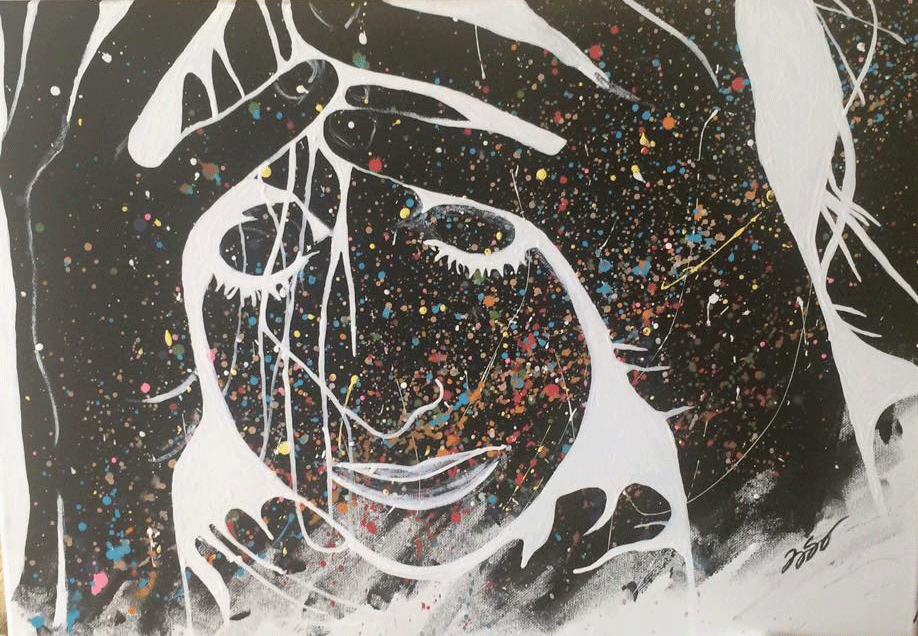
Soul Search

why do you let them?

come and leave?

like them and

love you, too?

what is the reason

behind settling for

sticks and stones?

for dimming your glow?

how come half their heart

is good enough for all or

your soul?

you bend back and break

bones for themin your home–

and yet they are allowed to stay

and make a mess of you.

why do you let them?

by Alex Elle

To August

Tumbling down

a leaf as i leave you

with smokey memories and warm nights

I guess the Fall came fast enough

but there were days that stagnated

i needed

Reading the signs of change

like clasped hands cluctching knuckle skin

so long summer

catching weedles in the weeds 

stinging needles from fat rains

immaturities

brown eyed honesty

i guess we both knew the end would 

come for us

always,

always and never.


Districts Of Immersion


Long after the mothers uncross

their arms and the children who huddle

and wrap their shoulders in towels

stop shivering, when atop the tower the lifeguard collapses his red umbrella,

the beach is shorn of leisure and the colossal night is a call to worship for the anchorite

who heaves churns and roars against the planet’s decree as it prays,

and leaning in me you ask what could a sea this terrible and perfect possibly ever pray for:

waves smack in the jetty again and again and again as if asking for one thing.

We draw our blankets tight.

More and more we think we hear it.

by John Ebersole

On Returning Home To Nana’s

a small hair sprouts

defying the odds

bursting through the surface

only to crinkle and bend

like palm trees in the wind

coconut oil eases the shaft

from root to ends

smooth, dipping my curls

into the Atlantic

becoming one with the island

and the wave

and the nappiness

of my kitchen

the way she might have as a child on family vacations

her thick black locs hang

like freedom

and nooses

and mangoes

strong and sweet as sugarcane

standing up

resisting gravity

and the box that bottles beauty

Blue In Green

i fell in love with my bestfriend

where the tall grass grows

in the shadows

that which we call friend

by any other name is as sweet

so we played hide and seek 

with our hearts

until the colors ran out of time

drowned in an awkward silence

i walk about my emotions

he ran

into my arms

warm

as the ground after a sand storm

bitter jazz

dripped from his cheek

as we speak of 

the first days spinning into ever

fades the call of the trumpet

for something new

not friendship but the best of us

hidden

like a foreign constellation

among galaxies

colliding

syncopating 

burning our music into existence

from humble beginnings

we danced

the world into a circle on its axis 

History

 
Where cloudbursts tore a gash
in the shoulder of the ridge,
uprooting ferns and hedge,
a maple and an ash,
a honeysuckle vine
and wires of gold ground pine,
the slide exposed a vein
of mica, groundhog den,
a zone of luminous clay,
revealing rocks like teeth,
a seam of yellow earth,
and brought to light of noon,
after half a millennium,
there in the mud, a shining
coin of the Spanish king.
by Robert Morgan

Paperboy

Disabled,
out of work,
out of workman’s compensation,
he works a paper route.
Seven days a week at six a.m.,
he places the papers gently.
Never lobs them,
never leaves them in the dewy lawn .
He abides every instruction:
 
      If the Buick is gone, leave the paper on the porch.
      Throw it over the dogs, if they’re out.
      Come on in, help yourself to some coffee.
 
He delivers his papers to people:
Dusty. Double D. Agnes. Herbie.
He knows about their kids–
how many they have,
how often they visit.
They know how he takes his coffee, black.
 
Tony Mac.
Husband of Sue.
Father of three.
Retired machine operator,
with bad back, neck, knees.
Their paperboy,
a man measured in more than column inches, rides a Harley without a helmet, drives his mother to her appointments, and has two Shih Tzu, Zed and Dude.
 
Little do they know
about the Thursdays
before the dumpsters roll through,
when he works over the trash waiting to be collected.
He collects the remnants of lives discarded, and leaves newspapers in exchange for their VCRs, lawn chairs, trinkets.
He takes his coffee black and quick
and returns to his route. He’s home by 7 to help his wife off to work.
In with her sandwich, a note
scratched out on a purple Post-it:
Tonight, you will have a present waiting, my love.
by Autumn Konopka

Hearts Weren’t Born Broken

broken winged

an eagle could not fly

so she dove down to earth

caught the pharoah’s eye

he liked the hurt bird

and without a word

ordered her taken care of


nights they’d watch

the moon unfurl

itself from the sky

his love healed her heart

but still she could not fly


deep in the darkness a coup

burnt his palace to the ground

and slaughtered his child

dethroned

he wandered

the desert alone


broken hearted

the king could not sing

so he laid

in the salt to die


above the cloud

he heard his eagle cry

with swift wings

she brings

a sack of water and gold


days went by

and the water went dry

fearing for her life

he left

while she slept

plunging into the depth

of the sun

he bargained his soul for her to be spared


where she lay in the sands

rose a lush mountain

she screamed to the heavens

abandoned

lonely

until her claws were stone

awaiting his return.


“After great pain, a formal feeling comes—” (341)

After great pain, a formal feeling comes—
The Nerves sit ceremonious, like Tombs—
The stiff Heart questions was it He, that bore,
And Yesterday, or Centuries before?
The Feet, mechanical, go round—
Of Ground, or Air, or Ought—
A Wooden way
Regardless grown,
A Quartz contentment, like a stone—

This is the Hour of Lead—
Remembered, if outlived,
As Freezing persons recollect the Snow—
First—Chill—then Stupor—then the letting go—

by Emily Dickinson (1830–1886)

An Old Woman Remembers

This poem tells a story of the 1906 Atlanta riots.

Her eyes were gentle, her voice was for soft singing

In the stiff-backed pew, or on the porch when evening

Comes slowly over Atlanta. But she remembered.

She said: “After they cleaned out the saloons and the dives

The drunks and the loafers, the thought that  they had better

Clean out the rest of us. And it was awful.

They snatched men off of streetcars, beat up women.

Some of our men fought back and killed, too. Still

It wasn’t their habit. And then the orders came

For the milishy, and the mob went home,

And dressed up in their soldiers’ uniforms,

And rushed back shooting just as wild as ever.

Some leaders told us to keep  faith in the law,

In the governor; some did not keep that faith,

Some never had it; he was white, too, and the time

Was near election, and the rebs were mad.

He wasn’t stopping hornets with his head bare.

The white folks at the big houses, some of them

Kept all their servants home under protection

But that was all the trouble they could stand.

And some were put out when their cooks and yard-boys

Were thrown from cars and beaten, and came late or not at all.

And the police they helped the mob, and the milishy

They helped the police. And it got worse and worse.

“They broke into groceries, drugstores, barbershops,

it made no difference whether white or black.

They beat a lame bootblack until he died,

They cut an old man open with jackknives

The newspapers named us black brutes and mad dogs.

So they used a gun butt on the president

Of our seminary where a lot of folks

Had set up praying prayers the whole night through.

And then, “she said, “our folks got sick and tired

Of being chased and beaten and shot down.

All of a sudden, one day, they all got sick and tired

The servants they put down their mops and pans

And brooms and hoes and rakes and coachman whips,

Bad niggers stopped their drinking Dago red,

Good Negroes figured they had prayed enough,

All came back home–they had been too long away–

A lot of visitors had been looking for them.

They sat on their front stoops and in their yards,

Not talking much, but ready; their welcome ready:

Their shotguns oiled and loaded on their knees.


“And then

There wasn’t any riot anymore.”


by Sterling Brown